Trusted Bathroom & Entryway Accessibility for Aging in Place
Bathroom and entryway modifications are among the most impactful aging-in-place upgrades. We connect families with certified contractors for curbless shower conversions, wider doorway installations, zero-step entry modifications, and full ADA-compliant bathroom remodels. These upgrades address the most common accessibility barriers that lead to falls and loss of independence.
What Bathroom Access Include
Why Bathroom and Entryway Accessibility Matters Most
When families begin evaluating whether a senior loved one can continue living safely at home, two areas consistently emerge as the most critical barriers: the bathroom and the home’s entry points. These are the spaces where the physical demands of daily living most directly confront the realities of age-related mobility changes.
The bathroom requires some of the most physically challenging movements performed in daily life. Stepping over a tub wall, lowering onto a toilet seat, standing on wet surfaces, and managing personal hygiene tasks all require balance, strength, and coordination that naturally decline with age. According to the CDC, approximately 235,000 people over the age of 15 visit emergency departments each year for injuries suffered in the bathroom, with seniors accounting for a disproportionate share of the most serious injuries.
Home entry presents a parallel challenge. Steps at the front door, back door, or garage entry must be navigated multiple times daily and become increasingly hazardous as mobility decreases. For someone who uses a walker or wheelchair, even a single step can render an entry point impassable, effectively trapping them inside or requiring assistance for every departure and return.
By addressing both bathroom and entryway accessibility together, families can eliminate the two most common triggers for facility placement conversations and extend independent living by years.
Curbless Showers: The Gold Standard in Accessible Bathing
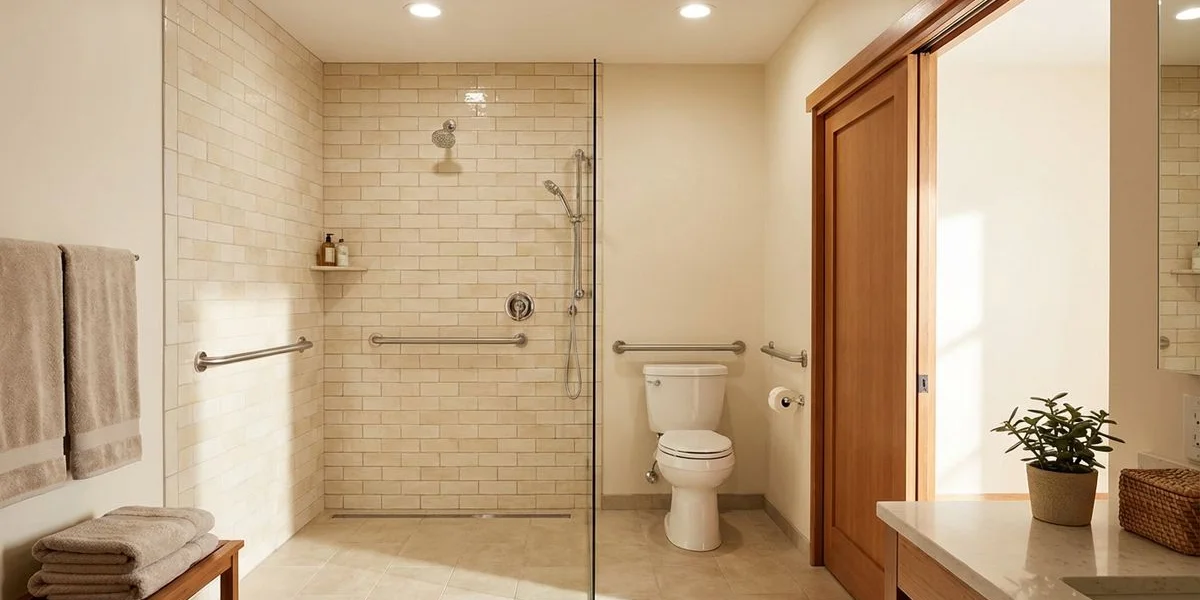
Curbless showers represent the most significant advancement in accessible bathroom design. By eliminating the raised threshold that surrounds a standard shower pan, curbless designs create a seamless floor transition that is safe for anyone, regardless of mobility level.
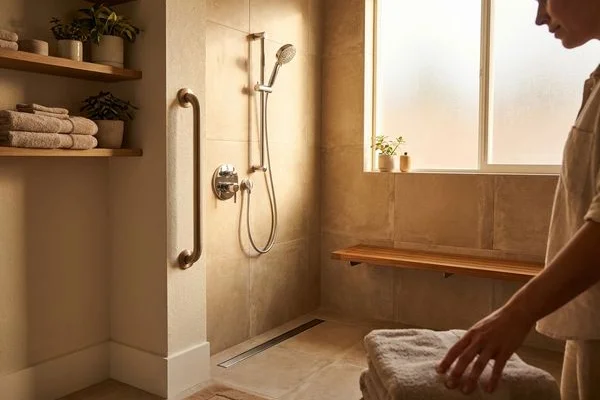
How curbless showers work: The shower floor is built with a gentle slope toward a linear drain, typically a gradient of one-quarter inch per foot. This slope is subtle enough to be nearly imperceptible while walking but effective enough to direct water flow toward the drain and away from the bathroom floor. A waterproof membrane beneath the tile extends several inches beyond the shower area, providing comprehensive water protection.
Built-in bench seating transforms the shower from a standing-only activity into one that can be performed comfortably seated. Bench seats are constructed from waterproof materials and tiled to match the shower surroundings. They provide a secure seating surface for bathing, foot washing, and the sit-to-stand transitions that are often the most challenging moments in the bathing process.
Handheld shower heads on adjustable slide bars allow the water stream to be positioned at any height, from seated level to full standing height. This versatility means the shower accommodates the user whether they are standing independently, using a shower chair, or seated on the built-in bench. Quality handheld units include pause buttons that allow temporary water stoppage without adjusting the temperature.
Linear drain systems are not only functionally superior to center drains but also aesthetically modern. Positioned along one edge of the shower floor, linear drains handle higher water volume, reduce standing water, and create a cleaner design line. Many linear drains come in architectural finishes that complement the overall bathroom design.
Design Note: A well-designed curbless shower can actually make your bathroom feel larger and more modern. The seamless floor transition creates visual flow that expands the perceived space, which is why curbless designs are popular in luxury home renovations regardless of accessibility needs.
Doorway Widening and Passage Optimization
Standard residential doorways were designed for walking adults and typically measure 28 to 30 inches in clear opening width. This is insufficient for comfortable wheelchair passage, tight for walker use, and can create bottleneck hazards for anyone with limited mobility.
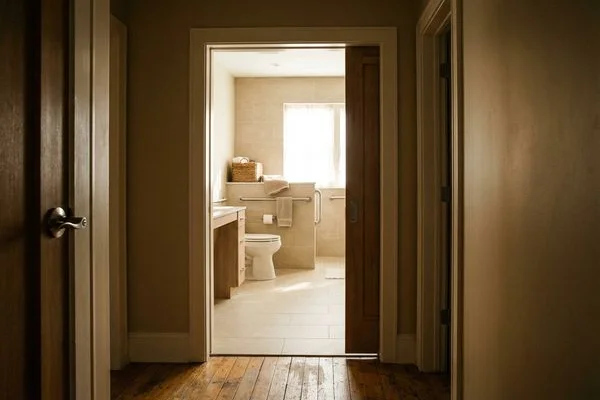
ADA clearance requirements specify a minimum 32-inch clear opening, with 36 inches recommended for comfortable passage. Achieving this width from a standard doorway requires removing the existing door frame and installing a wider one, a project that typically involves framing modifications but rarely requires structural changes to load-bearing walls.
Pocket doors are an excellent solution for bathrooms and small spaces. Unlike swing doors that consume floor space and can block passage, pocket doors slide into the wall cavity. This eliminates the door swing entirely, maximizing usable space and providing clear passage even in tight configurations.
Offset hinges offer a quick fix that can add up to two inches of clear opening width without door frame replacement. These special hinges swing the door completely clear of the frame when open, converting every inch of the existing opening into usable passage width.
Lever-style handles replace traditional round door knobs throughout the home. Lever handles require no gripping or twisting motion, making them operable by anyone regardless of hand strength, dexterity, or range of motion. They can be operated with a closed fist, the back of the hand, or an elbow.
Zero-Step Entries: Coming and Going Safely
The concept of zero-step entry addresses one of the most fundamental accessibility requirements: the ability to enter and exit your own home safely without navigating steps.
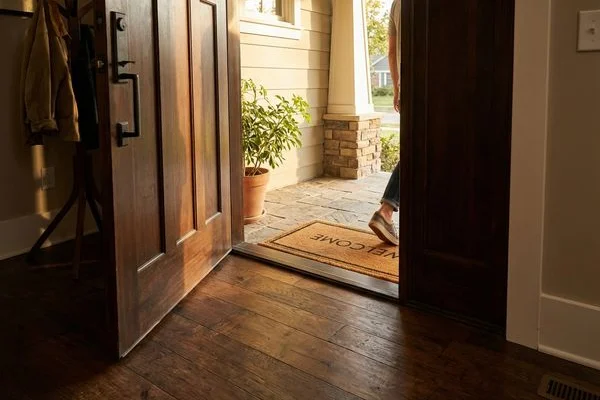
What qualifies as zero-step: A true zero-step entry has no elevation change between the outdoor approach surface and the interior floor level. The threshold between outside and inside is flush, allowing smooth passage for walking, wheeled mobility devices, and even rolling luggage or groceries.
How zero-step entries are created: In new construction, zero-step entries are planned into the foundation design. In existing homes, there are several approaches. Grading and landscaping can raise the exterior approach to match the interior floor level. Ramp structures can provide gradual elevation change. In some cases, the entry threshold itself can be lowered and waterproofed to create a flush transition.
Weather protection is a critical consideration for zero-step entries. Without a step to act as a water barrier, proper drainage, sloped grading away from the entry, and adequate overhang or covered porch design are essential to prevent water intrusion.
ADA-Compliant Fixture Selection
Choosing the right fixtures for an accessible bathroom involves understanding both the functional requirements and the aesthetic possibilities.
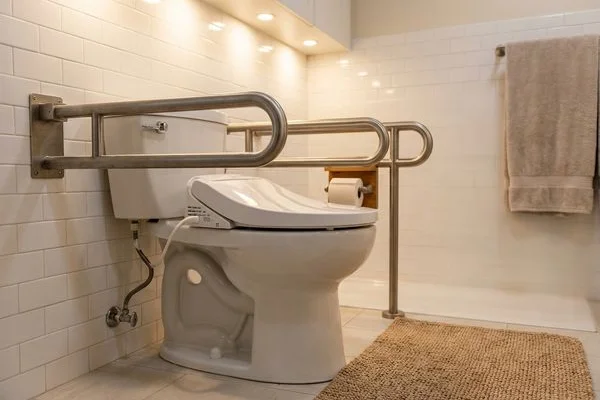
Comfort-height toilets sit 17 to 19 inches from floor to seat top, compared to the 14 to 15 inches of standard models. This height aligns more closely with a standard chair, making the sit-to-stand transition significantly easier. Wall-mounted models allow custom height adjustment and simplify floor cleaning beneath the fixture.
ADA-compliant faucets use lever or single-handle designs that require minimal force and dexterity to operate. Thermostatic mixing valves prevent scalding by limiting maximum water temperature, an essential safety feature given that many seniors have reduced heat sensitivity.
Bidet toilet seats have become an important accessibility feature. They reduce or eliminate the need for the twisting and reaching motions required by toilet paper, which can be challenging for seniors with limited upper body mobility or shoulder arthritis.
Adjustable-height vanities accommodate users who may need to sit while grooming. Wall-mounted vanities can be installed at custom heights, and some models include adjustable mechanisms that allow the vanity to be raised or lowered as needs change over time.
Planning Your Accessibility Renovation
A successful accessibility renovation balances immediate needs with potential future requirements, ensuring that the investment made today continues to serve your family as conditions evolve.
Start with the highest-impact changes identified in your home safety assessment. For most families, this means addressing bathroom grab bars, shower accessibility, and the primary home entry point. These modifications eliminate the most dangerous daily hazards and provide immediate quality-of-life improvements.
Plan for progression by choosing modifications that accommodate a range of mobility levels. A curbless shower that works perfectly for someone who walks with a cane today will also work for someone who uses a wheelchair in the future. This forward-thinking approach prevents the need for multiple renovation cycles.
Consider Universal Design for modifications that affect shared spaces. Universal Design features are functional for people of all ages and abilities, meaning that bathroom upgrades benefit the entire household, not just the senior family member. Lever handles, comfort-height toilets, and curbless showers are improvements that everyone appreciates.
Budget strategically by understanding which modifications provide the greatest return on safety investment. Grab bars at $100 to $300 each offer exceptional value. Comfort-height toilet installation at $300 to $600 provides daily quality-of-life improvement. Curbless shower conversion at $4,000 to $8,000 addresses the highest-risk daily activity. Each investment should be evaluated against the alternative cost of facility placement at $5,000 to $8,000 per month.
Contact our team today to schedule a free accessibility audit and begin transforming your bathroom and entryways into safe, beautiful, fully accessible spaces that support independent living for years to come.
Bathroom Access Pricing Options
One-time investments that cost a fraction of annual facility care.
Essential Upgrades
- Comfort-height toilet installation
- Lever-style handle replacement
- Grab bars in key locations
Curbless Shower Conversion
- Full curbless shower build-out
- Built-in shower bench
- Handheld shower head
- Linear drain system
Complete Accessible Remodel
- Curbless shower conversion
- Wider doorway installation
- ADA-compliant fixtures throughout
- Non-slip flooring
- Zero-step entry modification
Why Families Choose Our Bathroom Access
Universal Design Principles
Our modifications follow Universal Design philosophy, meaning they improve accessibility for seniors while remaining attractive and functional for all household members regardless of age or ability.
ADA-Compliant Standards
Every modification meets or exceeds Americans with Disabilities Act standards, ensuring proper clearances, heights, and features that accommodate a wide range of mobility needs.
Vetted Contractor Network
We connect you with contractors who hold specific certifications in aging-in-place and accessible construction, ensuring the work is done correctly the first time by experienced professionals.
Increases Home Value
Well-executed bathroom accessibility upgrades add measurable value to your home. As demand for accessible housing grows with the aging population, these modifications become premium selling features.
Preserves Independence Longer
Bathroom and entry barriers are among the first challenges that force facility placement. Addressing these barriers early extends the window of safe independent living by years in many cases.
How Bathroom Access Work
Accessibility Audit
A certified specialist evaluates your bathroom and entryway dimensions, identifies specific barriers, and assesses plumbing and structural conditions to determine the scope of modifications needed.
Design Consultation
Working with your preferences and budget, we create a design plan that balances accessibility requirements with aesthetic goals, selecting fixtures, finishes, and layouts that work for your space.
Contractor-Led Renovation
Vetted, certified contractors handle all construction including demolition, plumbing, electrical, waterproofing, tile work, and fixture installation to code and ADA standards.
Final Inspection
Your specialist conducts a thorough inspection verifying ADA compliance, proper waterproofing, fixture functionality, and user satisfaction before the project is considered complete.
Save $50,000+ Per Year With Home Safety Modifications
A one-time investment in bathroom access costs a fraction of annual assisted living fees. Get a free assessment to see your potential savings.
Get a Free AssessmentSee Our Work
What Families Say About Bathroom Access
"The curbless shower conversion changed Mom's life. She went from being afraid to shower to looking forward to it. The built-in bench and handheld shower head give her complete independence. The tile work is beautiful and you would never know it was an accessibility modification."
"Widening the bathroom doorway and installing a comfort-height toilet were relatively simple changes that made an enormous difference for my father who uses a wheelchair. The contractor was knowledgeable about ADA requirements and the work was completed in just three days."
"We were quoted over $7,000 a month for assisted living because Dad could not safely get in and out of the house or use the bathroom. The zero-step entry and accessible bathroom remodel cost $12,000 total and solved both problems permanently. The savings over facility care are incredible."
Common Questions About Bathroom Access
What is a curbless shower and why is it safer?
How wide do doorways need to be for wheelchair accessibility?
What is a zero-step entry?
How long does a bathroom accessibility remodel take?
Can I make my bathroom accessible without a full remodel?
What is a comfort-height toilet?
Are lever-style door handles really that important?
Will my homeowner's insurance cover accessibility modifications?
Related Home Safety Solutions
Fall Prevention
Expert-recommended modifications including grab bars, improved lighting, and non-slip surfaces to prevent falls.
Learn More →Safety Assessments
Room-by-room safety assessments identifying fall risks, accessibility barriers, and recommended modifications.
Learn More →Walk-in Tubs
Low-threshold entry tubs with anti-slip flooring and hydrotherapy features designed for safe, independent bathing.
Learn More →Try Our Free Cost Calculator
Compare the cost of home modifications versus assisted living to see how much your family can save.
Use Cost CalculatorGet Your Free Bathroom Access Assessment
Take the first step toward a safer home. Our certified specialists help you understand your options, estimated costs, and potential savings versus facility care.
Get a Free Assessment