How to Budget for Aging in Place: A Family Financial Planning Guide
Step-by-step financial planning guide for aging in place.


Why a Budget Makes Aging in Place Possible
Aging in place without a financial plan is like building a house without a blueprint. You might get lucky, or you might run out of money at the worst possible time. The families who successfully navigate aging in place share one thing in common: they plan the financial side as carefully as they plan the physical modifications.
After helping hundreds of families develop aging-in-place strategies through home safety assessments, we have seen firsthand how proper budgeting transforms what feels like an overwhelming expense into a manageable, phased investment. The total cost of aging in place is almost always lower than facility care, but only if you plan for all the expenses, not just the obvious ones.
We designed this guide to walk you through building a comprehensive aging-in-place budget. It covers costs that most families overlook, phasing strategies that spread the financial burden, and funding sources that can significantly reduce out-of-pocket expenses.
The Four Categories of Aging-in-Place Costs
Every aging-in-place budget should address four categories. Ignoring any one of them leads to financial surprises.
Category 1: One-Time Home Modifications
These are the physical changes to the home that make it safe and accessible. The scope depends on the home’s current condition and the senior’s mobility and health needs.
Essential Modifications (Almost Every Home):
| Modification | 2026 Cost Range (Installed) | Priority |
|---|---|---|
| Grab bars (bathroom set) | $150 - $400 | Immediate |
| Non-slip flooring (bathroom) | $600 - $2,500 | Immediate |
| Improved lighting (LED/Smart) | $600 - $2,200 | Immediate |
| Lever door handles | $250 - $700 | Immediate |
| Smart Smoke/CO detectors | $350 - $700 | Immediate |
| Essential Total | $1,950 - $6,500 | — |
Common Modifications (Based on Need):
| Modification | Cost Range | When Needed |
|---|---|---|
| Walk-in shower or tub | $12,000 - $15,000 | Mobility decline |
| Stair lift (straight) | $3,400 - $10,000 | Stair difficulty |
| Modular wheelchair ramp | $1,500 - $5,000 | Wheelchair/walker use |
| Widened doorways (per door) | $750 - $2,500 | Wheelchair access |
| First-floor bedroom conversion | $6,000 - $30,000 | Cannot use stairs |
| Lowered kitchen counters | $3,000 - $10,000 | Wheelchair use |
| Common Total | $26,650 - $72,500 | — |
Realistic planning range for most families: $18,000 to $45,000 for a comprehensive modification package in 2026.
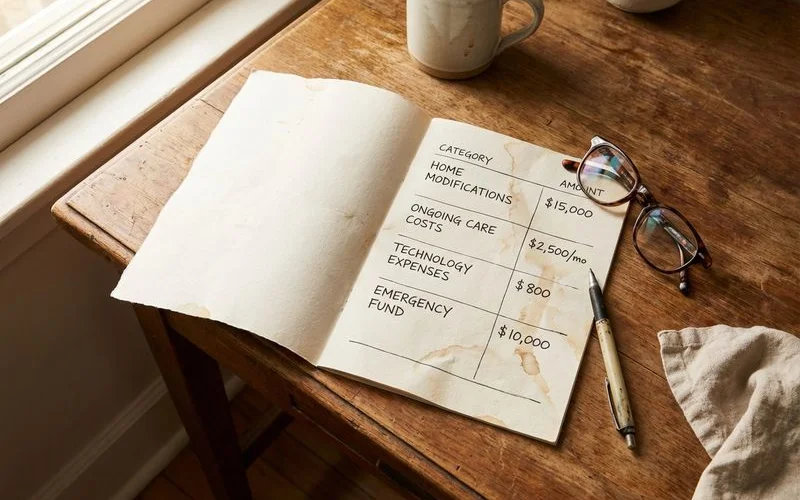 A comprehensive aging-in-place budget covers four major categories of expenses
Category 2: Ongoing Care and Support
This category typically represents the largest long-term cost. Even with excellent home modifications, most seniors eventually need some level of regular assistance.
We strongly recommend budgeting based on agency rates rather than private hires to ensure reliability and insurance coverage.
| Care Level | Hours/Week | Monthly Cost (Agency Avg) | Annual Cost |
|---|---|---|---|
| Weekly housekeeping | 3-4 | $450 - $650 | $5,400 - $7,800 |
| Companion care | 10-15 | $1,400 - $2,200 | $16,800 - $26,400 |
| Personal care aide | 15-25 | $2,200 - $4,500 | $26,400 - $54,000 |
| Part-time health aide | 20-30 | $3,800 - $6,500 | $45,600 - $78,000 |
| Full-time care | 40-50 | $7,500 - $13,000 | $90,000 - $156,000 |
Budget planning tip: Care costs rarely start at the maximum. A common progression follows this timeline:
- Years 1-3: Weekly housekeeping and occasional help ($450-$900/month)
- Years 4-6: Part-time companion or personal care ($1,600-$3,200/month)
- Years 7-10: More intensive daily care ($3,800-$7,500/month)
Category 3: Technology and Monitoring
Technology costs include both one-time hardware purchases and ongoing subscription fees.
Reliable systems like Medical Guardian or Bay Alarm Medical offer professional monitoring, while unmonitored options like LogicMark provide a budget-friendly alternative with no monthly fees.
| Technology | One-Time Cost | Monthly Cost | Annual Cost |
|---|---|---|---|
| Medical alert system (GPS) | $50 - $200 | $30 - $60 | $360 - $720 |
| Smart home sensors | $250 - $600 | $0 - $40 | $0 - $480 |
| Smart medication dispenser | $100 - $400 | $35 - $65 | $420 - $780 |
| Video doorbell (e.g., Ring) | $100 - $250 | $4 - $12 | $48 - $144 |
| Smart thermostat | $130 - $300 | $0 | $0 |
| Activity monitoring service | $200 - $500 | $35 - $80 | $420 - $960 |
| Technology Total | $830 - $2,250 | $104 - $257 | $1,248 - $3,084 |
For a comprehensive overview of the best technology options, see our guide on smart home devices for aging in place.
Category 4: Emergency and Contingency Fund
This is the category most families forget, and it causes significant financial stress when unexpected expenses arise.
What to plan for in 2026:
- Emergency home repairs: Furnace replacement ($3,000-$6,000), roof repair ($1,000-$3,000), or plumbing emergencies ($600-$3,500).
- Medical gaps: Emergency room copays, sudden medication changes, or specialized rehabilitation equipment not fully covered by Medicare.
- Temporary care surges: If a primary family caregiver gets the flu or needs a break, you may need to hire agency care at $35+ per hour for a week or two.
- Maintenance catch-up: Seniors often defer maintenance to save money, eventually creating expensive backlog issues.
Recommended emergency fund: Keep $12,000 to $25,000 in a liquid, accessible account.
Building Your 10-Year Budget
Here is a realistic 10-year aging-in-place budget for a senior with moderate and increasing care needs.
We have adjusted these numbers to reflect 2026 labor and material costs.
| Year | Home Mods | Care | Technology | Maintenance | Total |
|---|---|---|---|---|---|
| 1 | $28,000 | $7,800 | $2,800 | $3,500 | $42,100 |
| 2 | $2,500 | $10,400 | $700 | $3,500 | $17,100 |
| 3 | $2,500 | $15,600 | $700 | $3,500 | $22,300 |
| 4 | $6,000 | $26,400 | $900 | $4,000 | $37,300 |
| 5 | $0 | $33,000 | $700 | $4,000 | $37,700 |
| 6 | $3,500 | $39,600 | $1,200 | $4,500 | $48,800 |
| 7 | $0 | $52,000 | $700 | $4,500 | $57,200 |
| 8 | $6,000 | $65,000 | $900 | $4,500 | $76,400 |
| 9 | $0 | $78,000 | $700 | $5,000 | $83,700 |
| 10 | $0 | $91,000 | $900 | $5,000 | $96,900 |
| Total | $48,500 | $418,800 | $10,200 | $42,000 | $519,500 |
Compare to assisted living: The national median for assisted living has risen to approximately $5,900 per month ($70,800 annually). Over 10 years, assuming a 4% annual increase, facility care would cost between $708,000 and $1,150,000.
The Bottom Line: The savings from aging in place in this scenario range from $188,000 to $630,000 over a decade.
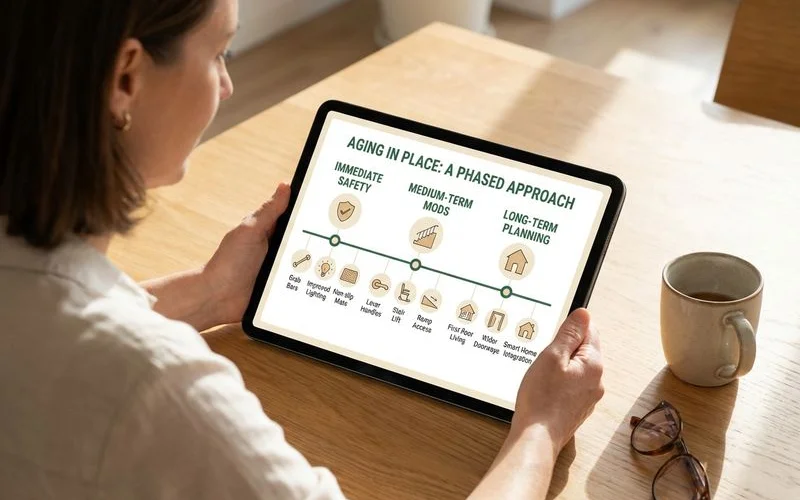 Phasing modifications over time makes the financial commitment more manageable
The Phasing Strategy: Spreading Costs Over Time
You do not need to do everything at once. A phased approach allows you to adapt the plan as your loved one’s needs change and spreads the cash flow requirement.
Phase 1: Immediate Safety (Month 1-3)
Budget: $3,500 - $9,000 Focus on the modifications that prevent the most common accidents, specifically falls in the bathroom and hallways.
- Install grab bars in all bathrooms.
- Improve lighting along high-traffic paths (motion-sensing night lights are cost-effective).
- Remove trip hazards like loose rugs and clutter.
- Install a medical alert system with fall detection.
- Add non-slip surfaces in showers and tubs.
Phase 2: Accessibility Enhancement (Month 3-12)
Budget: $12,000 - $30,000 Address the modifications that support daily independence and reduce physical strain.
- Bathroom accessibility upgrades (walk-in shower or tub cut-out).
- Stair management (stair lift or setting up a first-floor living space).
- Kitchen adjustments (pull-out shelves, automatic stove shut-off).
- Smart home technology integration (video doorbell, smart lock).
Phase 3: Ongoing Optimization (Year 2+)
Budget: Variable Adjust and expand based on evolving health conditions.
- Increase agency care hours as mobility or cognition declines.
- Upgrade technology as new solutions like radar-based fall detection become more affordable.
- Address new modification needs, such as a permanent wheelchair ramp.
- Replace equipment that wears out.
Funding Sources to Reduce Out-of-Pocket Costs
Several funding sources can significantly reduce what you pay directly. For a complete guide, see our detailed article on financial assistance for senior home modifications.
Key 2026 Funding Updates:
| Source | Potential Savings | Eligibility Notes |
|---|---|---|
| VA Aid & Attendance | Up to $2,424/mo (Single Veteran) | Wartime veterans with non-service connected disabilities. |
| Medicaid HCBS Waiver | $5,000 - $25,000 (Lifetime) | Income-eligible; requires nursing-home level of care needs. |
| Medicare Advantage | $1,000 - $3,000/year | Specific “Supplemental Benefits” plans (check Part C coverage). |
| Tax Deductions | Deduction for costs > 7.5% of AGI | Costs must be medically necessary (physician prescribed). |
| Rural Housing Repair | Up to $10,000 grant | USDA Section 504 for rural homeowners aged 62+ with low income. |
Important Tax Note: The IRS allows you to deduct qualified medical home improvements if total medical expenses exceed 7.5% of your Adjusted Gross Income (AGI). Additionally, for the 2026 tax year, the standard deduction for seniors (65+) includes an additional sum (approximately $1,950-$2,000 depending on filing status), which can also help offset tax liabilities.
Practical Steps to Start Your Budget
-
Schedule a professional assessment. Start with a home safety assessment to get a concrete list of needs. This gives you a “price tag” for the physical side of the equation so you aren’t guessing at renovation costs.
-
Project care costs with a physician. Discuss the expected health trajectory with your loved one’s doctor. If a condition is progressive (like dementia or Parkinson’s), budget for higher care hours in years 5-10.
-
Inventory your resources. List all assets including savings, home equity, long-term care insurance, and monthly income. Don’t forget to check the specific 2026 limits for VA benefits if the senior is a veteran.
-
Apply for assistance immediately. Many grant programs and Medicaid waivers have long waiting lists. Submit applications now, even if you don’t need the funds for another six months.
-
Build the emergency fund. Set aside that $12,000-$25,000 strictly for aging-in-place contingencies. Having this cash accessible prevents you from using high-interest credit cards during a crisis.
-
Review the plan annually. Revisit this budget every January. Inflation affects care rates and construction materials, so you need to adjust your savings goals to match current market prices.
Aging in place is not just an emotional decision; it is a strategic financial commitment. With clear planning, it provides a higher quality of life at a lower cost than facility alternatives. We encourage you to start early, be realistic about future needs, and utilize every available funding source to secure your loved one’s comfort and safety.
Ready to Take Action?
Learn more about our comprehensive home safety assessments solutions and how they can help your family.
Explore Home Safety Assessments About James Wilson
Home Safety Assessment Specialist
Certified home safety specialist with 10+ years of residential accessibility evaluation experience.
Related Articles
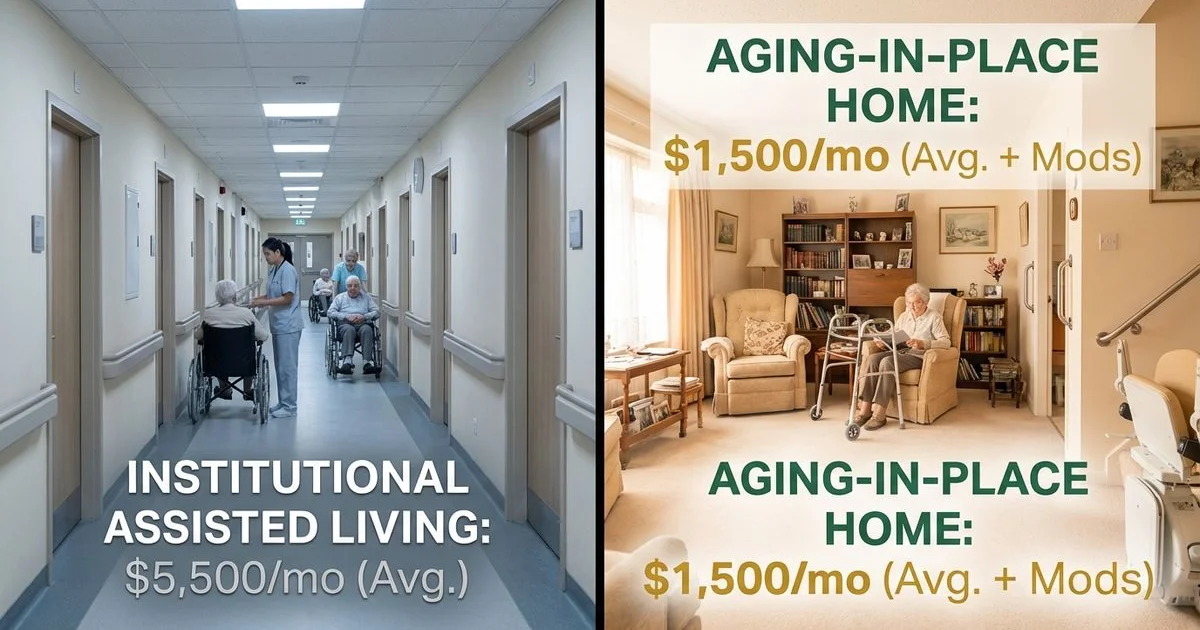
Assisted Living vs. Home Care: True Cost Comparison for 2026
Detailed cost comparison of assisted living facilities versus home care and aging-in-place modifications.
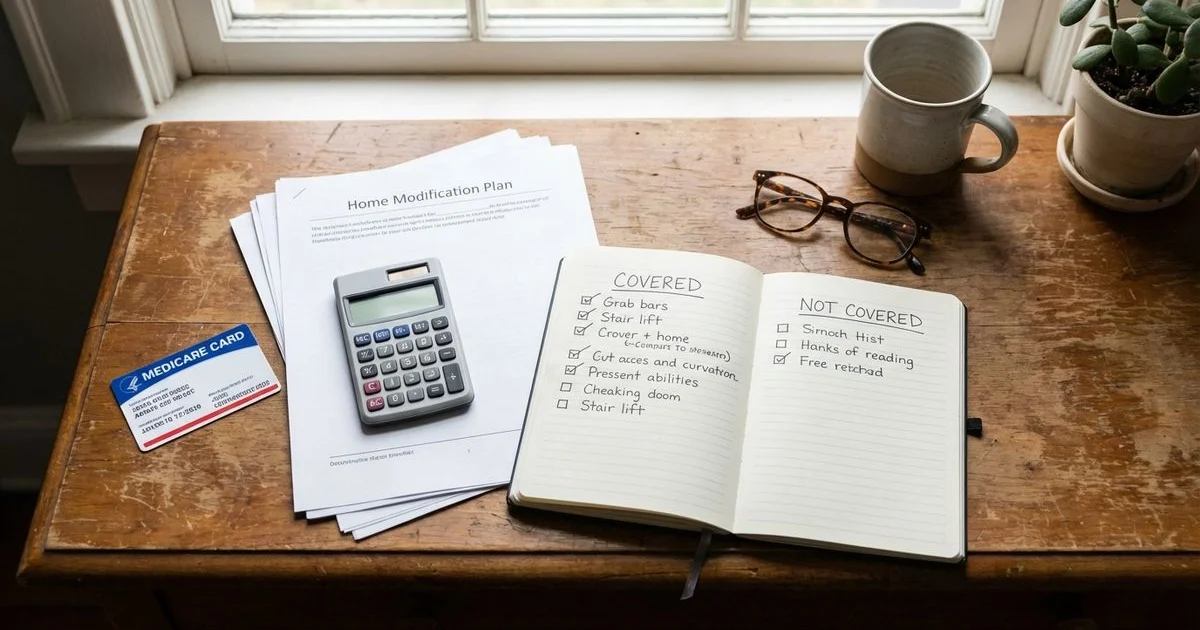
Does Medicare Cover Home Modifications? What's Covered and What's Not
Detailed breakdown of which aging-in-place modifications Medicare, Medicaid, and Medicare Advantage plans will and won't cover.
Senior Home Modification Grants, Loans & Assistance Programs
Complete guide to financial assistance for aging-in-place home modifications. Federal grants, state programs, VA benefits, and low-interest loans explained.