7 Alternatives to Stair Lifts for Seniors Who Need Multi-Level Access
Explore alternatives to stair lifts including home elevators, platform lifts, main-floor living conversions, and portable options for multi-level homes.

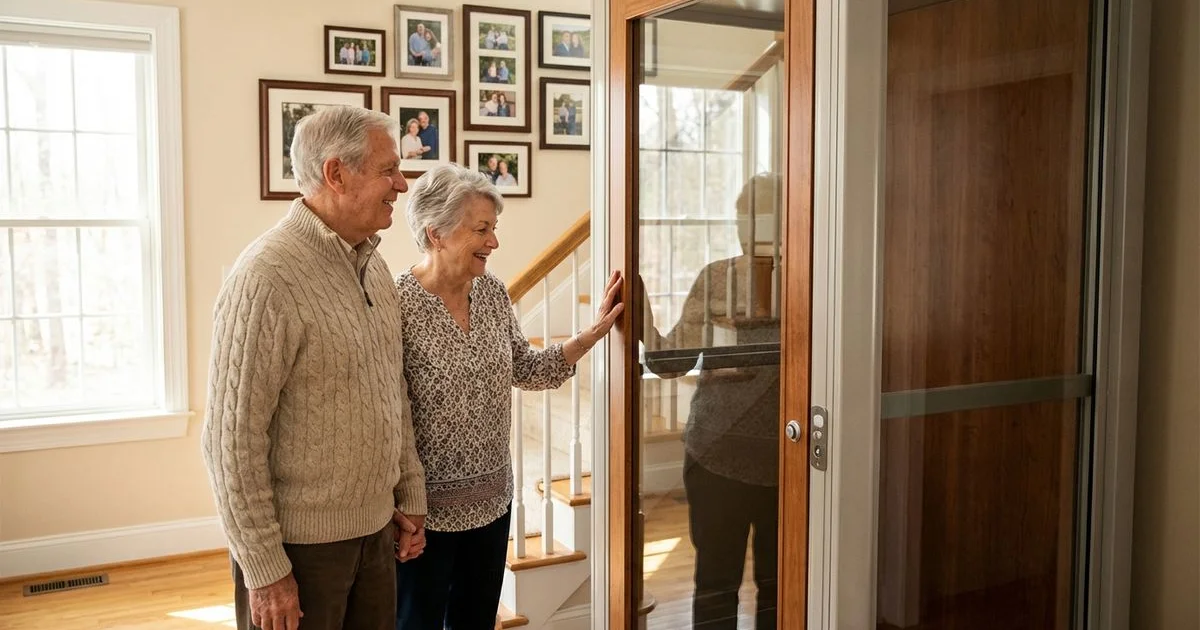
When a Stair Lift Is Not the Right Fit
We see this scenario constantly in our consultations. A family assumes a stair lift is their only option for aging in place. Yet upon closer inspection, we find that a wheelchair user cannot safely transfer to the seat or the staircase is simply too narrow to accommodate the rail.
Our team has spent years evaluating home accessibility solutions across the United States. While stair lifts are popular, they often fail to address complex mobility needs or specific architectural constraints.
We have compiled this guide to walk you through seven proven alternatives that go beyond the standard track-and-chair setup. You will find updated cost data for 2025, specific brand examples, and practical installation requirements below.
Alternative 1: Home Elevator
Cost: $25,000 - $65,000 installed Best for: Wheelchair users, homes with 3+ stories, families planning to age in place long-term
We consider the residential elevator the absolute gold standard for multi-level accessibility. It offers a seamless experience that preserves the user’s dignity and independence better than any other option.
Modern units have evolved significantly from the bulky, slow systems of the past. Companies like Stiltz and Pneumatic Vacuum Elevators (PVE) now offer “shaftless” technology that fits into spaces as tight as a standard closet.
Our installers frequently recommend these newer models because they minimize construction debris and installation time. A standard two-stop elevator can now fit within a footprint as small as 15 square feet.
Types of Home Elevators
| Type | Mechanism | Space Needed | Cost Range (2025) |
|---|---|---|---|
| Hydraulic | Fluid-powered piston | Machine room usually required | $28,000 - $55,000 |
| Traction | Cable and counterweight | Minimal overhead space | $32,000 - $65,000 |
| Pneumatic (Vacuum) | Air pressure differential | Self-contained tube (30-52” diameter) | $38,000 - $60,000 |
| Shaftless | Through-floor platform | No shaft needed | $22,000 - $45,000 |
We find that pneumatic elevators are particularly valuable for retrofits in older homes. Because they use air pressure rather than cables, they require no pit excavation and no separate machine room.
This self-contained design significantly reduces the contractor costs associated with structural modifications. The transparent cylindrical design also adds a modern aesthetic rather than looking like medical equipment.
Resale Value Impact
Home renovations rarely offer a 100% return on investment. However, a residential elevator is a rare exception in the accessibility market.
We see data consistently showing that an elevator can add $15,000 to $25,000 to a property’s resale value. As the “Silver Tsunami” of retiring Baby Boomers continues, the demand for move-in ready accessible homes is outpacing supply.
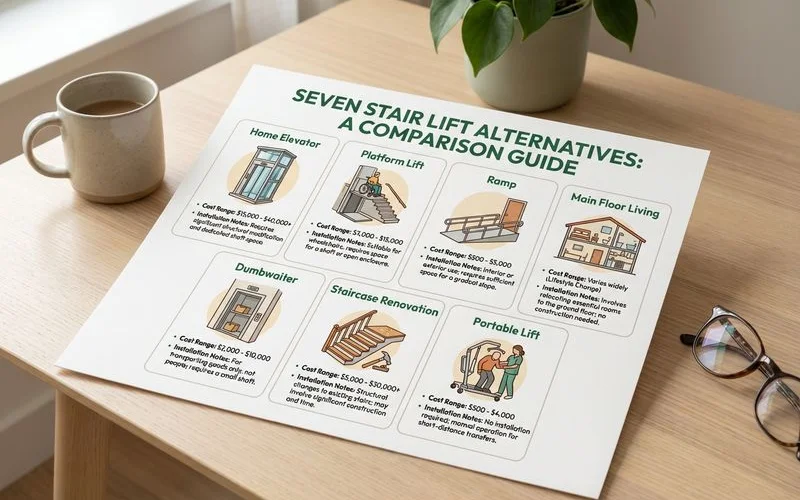 Each alternative serves different mobility needs and budget levels
Alternative 2: Vertical Platform Lift (Wheelchair Lift)
Cost: $6,000 - $18,000 installed Best for: Wheelchair users needing access over a short vertical distance (up to 14 feet)
We frequently recommend Vertical Platform Lifts (VPLs) for porch access or split-level interiors. These systems function like small, open-air elevators dedicated to lifting a wheelchair and its occupant straight up.
Manufacturers like Bruno and Harmar build these specifically to meet ASME A18.1 safety standards for residential use. They are robust, reliable, and designed to handle weather extremes.
Our technicians often install these in garages or at front entrances where a ramp would be too long to be feasible. For every 1 inch of rise, a ramp needs 12 inches of run, meaning a 24-inch porch rise requires a massive 24-foot ramp. A VPL solves this in a 5x5 foot footprint.
Key Advantages Over Stair Lifts
- Direct Roll-On Access: Accommodates wheelchairs and heavy power scooters without transferring.
- Cargo Capacity: Rated for 750 lbs on average (compared to 300-400 lbs for stair lifts).
- Versatility: Capable of carrying groceries, laundry, or luggage alongside the user.
- Durability: Available in weather-resistant outdoor models with IP-rated controls.
Alternative 3: Inclined Platform Lift
Cost: $10,000 - $28,000 installed Best for: Wheelchair users on staircases where a vertical lift is not feasible
We view the inclined platform lift (IPL) as a hybrid solution. It travels along the staircase rail like a stair lift but features a fold-down platform instead of a seat.
This allows a user to roll onto the platform and glide up the stairs while remaining in their wheelchair. It is a powerful solution for straight commercial stairs or wide residential staircases.
However, we always warn clients about the space requirements. An IPL generally requires a staircase width of at least 36 inches (and often more for curved rails), whereas a standard stair lift might only need 28 inches.
Operational Considerations
- Speed: These units move slower than stair lifts for safety reasons.
- Obstruction: When folded down for use, the platform blocks the entire staircase.
- Power: Most modern units, such as the Savaria Delta, run on battery power to ensure functionality during outages.
Alternative 4: Main-Floor Living Conversion
Cost: $8,000 - $50,000 depending on scope Best for: Seniors who can permanently relocate living to one floor
We often tell our clients that the best way to handle stairs is to stop using them. Creating a “universal design” suite on the ground floor eliminates the fall risk entirely.
This renovation typically involves converting a formal dining room or den into a bedroom. The most critical and expensive component is the bathroom.
Our construction teams find that converting a half-bath to a full, accessible wet room is the most common project scope. This involves expanding the footprint to allow for a 60-inch turning radius and installing a curbless shower.
Common Conversion Elements
- Bedroom creation: Adding closets and widening doorways to 32 inches clear width ($1,500 - $4,000).
- Bathroom modification: Converting a tub to a zero-entry shower ($8,000 - $18,000).
- New bathroom construction: Building a fully accessible bath from scratch ($20,000 - $35,000).
- Kitchen accessibility: Installing pull-down shelving and lever-style faucets ($3,000 - $10,000).
- Laundry relocation: moving hookups to the ground floor or installing a stackable unit in a closet ($4,000 - $9,000).
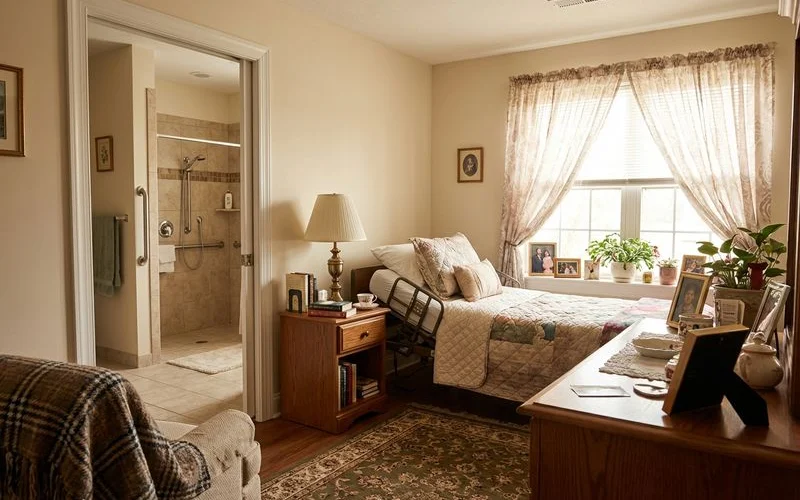 Converting to main-floor living eliminates stair use entirely
Financial Perspective: A comprehensive main-floor conversion may cost $20,000 to $40,000. While this seems high, we remind clients that the national median cost of assisted living is now over $54,000 per year. Combined with other aging-in-place modifications, this renovation often pays for itself in less than a year of extended independence.
Alternative 5: Portable Stair-Climbing Devices
Cost: $2,500 - $9,000 for the device Best for: Occasional stair use, travel, or temporary needs
We suggest portable stair climbers for families who need flexibility rather than a permanent installation. These are battery-operated machines that attach to a wheelchair (or have an integrated seat) and climb stairs using a caterpillar track or rotating arm mechanism.
Brands like Mobile Stairlift and Scalamobil are leaders in this niche. They allow a caregiver to transport a person up and down stairs safely without physical lifting.
Our safety experts emphasize that these are strictly attendant-operated devices. The user cannot operate them independently.
Limitations
- Operator Skill: Requires a trained caregiver with the physical confidence to guide the machine.
- Comfort: The motion can be jerky and may be unsettling for users with vertigo or anxiety.
- Weight: The units themselves can weigh 60+ lbs, making them difficult to load into a car trunk.
- Speed: Climbing a standard flight of stairs takes 3 to 5 minutes.
Alternative 6: Staircase Modification
Cost: $3,500 - $18,000 Best for: Seniors who can still walk stairs but need them to be safer and easier
We have found that many seniors do not need a mechanical lift yet. They simply need the staircase environment to be less hazardous.
Strategic carpentry and lighting upgrades can drastically reduce the risk of falls. The goal here is to improve stability, visibility, and geometry.
Our audits frequently reveal that existing handrails are decorative rather than functional. Replacing them with an ADA-compliant round rail (1.25 to 1.5 inches in diameter) allows for a “power grip” that can stop a fall.
Key Modifications
- Dual Handrails: Installing continuous rails on both sides extends safety for those with one-sided weakness ($800 - $2,500).
- High-Lumen Lighting: Adding motion-sensor LED strip lighting to stair nosings improves depth perception ($500 - $1,200).
- Traction Upgrades: Installing high-friction stair treads or removing slippery carpet runners ($400 - $1,500).
- Contrast Strips: Applying photo-luminescent strips to the edge of each step helps those with low vision ($200 - $500).
- Stair Widening: Structural modification to accommodate walkers ($6,000 - $18,000).
Alternative 7: Home Addition or Modular Addition
Cost: $40,000 - $120,000+ Best for: Families committed to long-term aging in place in their current home
We regard this as the most comprehensive solution available. Building an Accessory Dwelling Unit (ADU) or a “mother-in-law suite” addition solves the stair problem by creating a self-contained living space on the ground level.
Construction costs in the US have stabilized somewhat in 2025 but remain high. You can expect to pay between $200 and $400 per square foot for a high-quality accessible addition.
Our partners in the modular construction industry (using pre-fabricated sections) can often complete these projects in 4 to 8 weeks. This is significantly faster than the 4 to 6 months required for traditional stick-built additions.
Comparison Summary
| Alternative | Cost Range | Wheelchair Accessible | Independent Use | Installation Impact |
|---|---|---|---|---|
| Home Elevator | $25k - $65k | Yes | Yes | Major |
| Vertical Platform Lift | $6k - $18k | Yes | Yes | Moderate |
| Inclined Platform Lift | $10k - $28k | Yes | Yes | Moderate |
| Main-Floor Conversion | $8k - $50k | Varies | Yes | Moderate to Major |
| Portable Stair Climber | $2.5k - $9k | Yes | No (caregiver needed) | None |
| Staircase Modification | $3.5k - $18k | No | Yes | Minor |
| Home Addition | $40k - $120k+ | Yes | Yes | Major |
Choosing the Right Alternative
We know that every home and every diagnosis is unique. The “right” answer depends on the intersection of budget, prognosis, and architecture.
We recommend asking four critical questions to narrow the field:
- Is the user currently in a wheelchair? If yes, stair modifications are off the table. You need a vertical solution (Options 1, 2, or 3).
- What is the realistic budget? If capital is limited, a main-floor conversion of an existing room is often the most cost-effective path.
- Is this a temporary need? For recovery after surgery, renting a portable stair climber is smarter than construction.
- What is the resale plan? Elevators add value; extensive ramps or unique modifications might not.
For a complete overview of stair lift options (including the standard models these alternatives aim to replace), see our stair lift buying guide. A comprehensive home safety assessment from a CAPS-certified specialist can help you evaluate which solution best fits your home’s layout and your parent’s evolving mobility needs.
Ready to Take Action?
Learn more about our comprehensive stair lifts solutions and how they can help your family.
Explore Stair Lifts About James Wilson
Home Safety Specialist & Accessibility Consultant
Certified home safety specialist with 10+ years designing accessible living spaces for seniors and individuals with mobility challenges.
Related Articles
5 Evidence-Based Benefits of Hydrotherapy for Seniors
Research-backed benefits of hydrotherapy walk-in tubs for arthritis, chronic pain, and mobility issues in older adults.
The Complete Stair Lift Buying Guide: Straight vs. Curved, Costs & Features
Everything you need to know before purchasing a stair lift: types, costs, features, installation process, and top-rated brands for 2026.
Stair Lift Installation: What to Expect From Start to Finish
Step-by-step guide to stair lift installation process, timeline, and what to prepare. Covers measurement, customization, and post-installation care.