Expert Home Safety Assessments for Confident Aging in Place
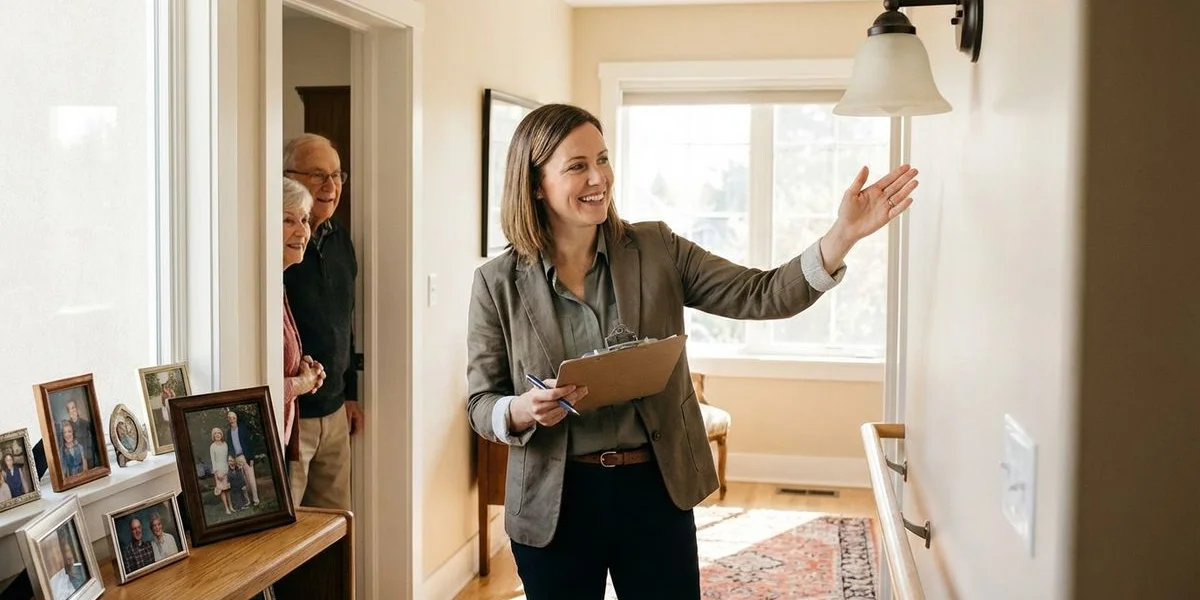
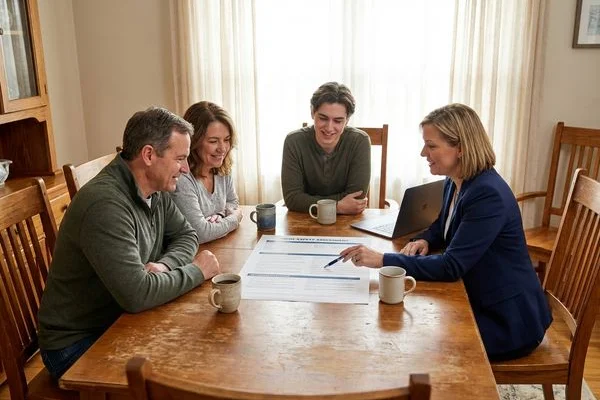
Our comprehensive home safety assessments evaluate every room in your home for fall risks, accessibility barriers, and safety hazards. Certified experts provide a detailed report with prioritized recommendations, estimated costs, and referrals to trusted local contractors. This assessment is the critical first step in any aging-in-place plan and can prevent costly emergency situations.
What Safety Assessments Include
Why Every Aging-in-Place Plan Starts with a Safety Assessment
A home safety assessment is the foundational step in any successful aging-in-place strategy. Just as you would not undergo surgery without a thorough medical evaluation, you should not invest in home modifications without first understanding exactly where the risks and opportunities exist in your specific living environment.
The Centers for Disease Control and Prevention reports that one in four Americans aged 65 and older falls each year, and falls are the leading cause of fatal and non-fatal injuries in this age group. The vast majority of these falls occur inside the home, in spaces that families have lived in for years without recognizing the hazards that develop as mobility and balance change with age.
A professional home safety assessment transforms what might feel like an overwhelming challenge into a clear, actionable roadmap. Rather than guessing which modifications to prioritize or relying on generic advice, you receive a customized evaluation based on your home’s specific layout, your loved one’s unique mobility profile, and the most current evidence-based safety standards.
What Gets Evaluated: The Room-by-Room Process
Our Certified Aging-in-Place Specialists follow a systematic evaluation protocol that examines every area of the home where your loved one moves, rests, or performs daily activities.
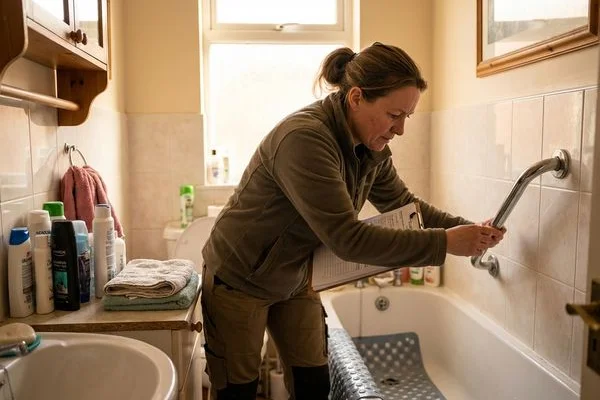
Bathroom evaluation is typically the most detailed portion of the assessment. The specialist examines tub and shower entry height, presence and placement of grab bars, floor surface slip resistance, toilet height and accessibility, lighting adequacy, and storage accessibility. Bathrooms account for more than 80 percent of fall-related injuries in the home, making this the highest-priority evaluation area.
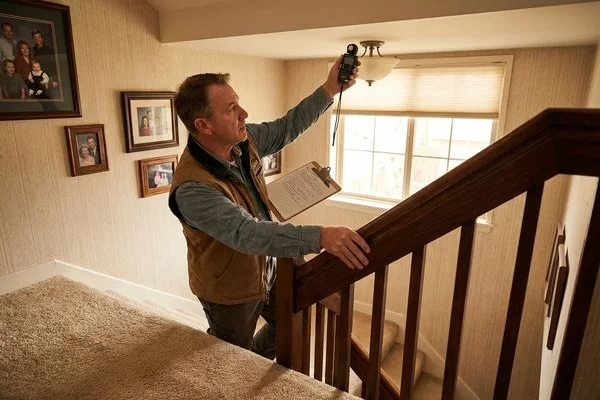
Staircase and hallway evaluation addresses the second most common fall location. The specialist checks handrail presence, height, and stability on both sides of every staircase. Stair tread condition, visibility of stair edges, lighting levels at the top and bottom of stairs, and hallway width for walker or wheelchair passage are all documented.
Kitchen evaluation focuses on accessibility and burn prevention. The specialist assesses counter heights, cabinet reachability, stove safety features, floor surface condition, lighting for food preparation tasks, and the arrangement of frequently used items relative to the user’s mobility range.
Bedroom evaluation examines bed height relative to safe transfers, nighttime pathway lighting to the bathroom, flooring and rug hazards, closet accessibility, and emergency response access such as telephone or medical alert device placement.
Living area evaluation covers furniture arrangement for clear pathways, electrical cord management, floor surface transitions between rooms, window and door hardware accessibility, and lighting control placement.
Exterior evaluation includes entry steps and ramps, walkway surface condition, outdoor lighting, mailbox accessibility, garage and vehicle access, and yard maintenance pathways.
Assessment Insight: On average, our specialists identify 8 to 15 individual safety concerns during a standard home assessment. Most homeowners are aware of only two or three of these risks before the professional evaluation.
Understanding the Assessment Report
The assessment report you receive within 48 hours of your evaluation is designed to be clear, actionable, and useful for decision-making at every budget level.
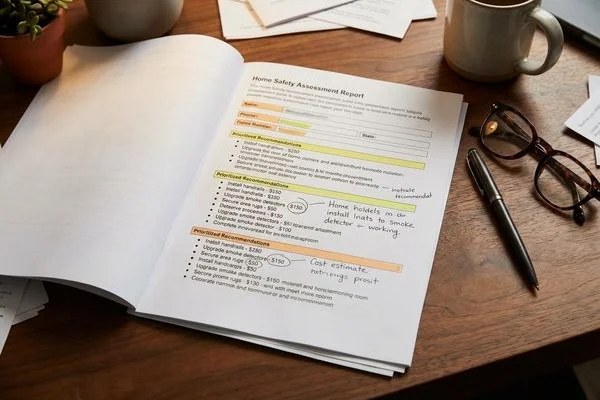
Priority classifications organize every recommendation into three tiers. Critical priorities address hazards with the highest fall risk or greatest injury potential and should be addressed immediately. Important priorities represent significant safety improvements that should be addressed within 30 to 90 days. Recommended priorities are beneficial enhancements that can be implemented as budget allows.
Cost estimates accompany each recommendation, giving you a realistic understanding of the investment required. Estimates include both product costs and installation labor, based on current pricing from local contractors in your metro area.
Photo documentation in the enhanced and comprehensive assessment tiers provides visual reference for each identified hazard. These photos are particularly useful when discussing modifications with contractors, family members who may not live locally, or insurance providers.
Product recommendations specify the type, size, and grade of safety equipment recommended for each location. For example, rather than simply recommending grab bars, the report specifies the length, diameter, mounting type, and ADA compliance rating appropriate for each specific installation location.
Who Should Get a Home Safety Assessment?
While every senior-occupied home can benefit from a professional safety evaluation, certain situations make an assessment particularly urgent.
After a fall or near-fall event, an assessment identifies the specific hazards that contributed to the incident and ensures all similar risks throughout the home are addressed before another event occurs.
When mobility changes are noticed, such as increased unsteadiness, new reliance on furniture for balance, or reluctance to use certain rooms or stairs, an assessment can identify modifications that restore confidence and access.
Before hospital discharge after a surgery, stroke, or other medical event that affects mobility. Hospitals often recommend home modifications before discharge, and a professional assessment ensures the home is properly prepared for the patient’s return.
When considering assisted living, a safety assessment often reveals that targeted home modifications costing $5,000 to $15,000 can safely delay or prevent a move to a facility costing $60,000 or more per year. The assessment provides the data needed to make this comparison objectively.
As a proactive measure for any senior living independently or with a spouse. The best time to address fall hazards is before a fall occurs, not after.
The Financial Case for Professional Assessment
The economics of home safety assessment are overwhelmingly favorable, even beyond the obvious comparison with assisted living costs.
Emergency room costs for fall-related injuries average $35,000 per incident, according to the CDC. A single prevented fall justifies the cost of even the most comprehensive assessment and modification plan many times over.
Insurance implications are worth considering. Some long-term care insurance policies offer premium discounts for homes that have undergone professional safety assessments and implemented recommended modifications. Our comprehensive plan tier includes documentation suitable for insurance submissions.
Property value can increase with well-executed accessibility modifications. As the baby boomer generation continues to age, homes with existing aging-in-place features command premium prices in many markets. The assessment report serves as a roadmap for value-adding improvements.
Medicaid and VA benefits may cover some modifications identified in the assessment. Our comprehensive plan tier includes guidance on available financial assistance programs in your state, potentially offsetting a significant portion of modification costs.
How Our Assessment Differs from a DIY Checklist
While online home safety checklists provide a useful starting point, a professional assessment offers several advantages that significantly improve outcomes.
Clinical perspective means our specialists understand how specific medical conditions affect fall risk and daily functioning. A checklist might flag the absence of a grab bar, but a specialist understands that a person with right-side weakness needs grab bars positioned on the left side, at a specific height, with a particular grip diameter.
Measurement precision ensures that recommended modifications will actually work in your space. Grab bars must be anchored into studs at specific locations. Ramp slopes must meet ADA grade requirements. Doorway widths must accommodate specific mobility equipment. A professional assessment captures these measurements accurately.
Holistic evaluation considers how changes in one area affect the entire home flow. For example, adding a ramp at the front door may require repositioning outdoor lighting, adjusting the door swing direction, and modifying the interior entryway flooring to create a seamless transition.
Local expertise means our specialists know which contractors in your metro area have the experience and certifications to perform aging-in-place modifications correctly. They also know current local building codes, permit requirements, and available financial assistance programs specific to your area.
Schedule your free home safety assessment today and take the most important first step toward keeping your loved one safely at home. Our Certified Aging-in-Place Specialists are available across 14 metro areas nationwide, and the assessment carries absolutely no obligation.
Safety Assessments Pricing Options
One-time investments that cost a fraction of annual facility care.
Standard Assessment
- Room-by-room evaluation
- Written report within 48 hours
- Prioritized recommendations
Enhanced Assessment
- All Standard features included
- Detailed photo documentation
- Product specification sheets
- Contractor cost estimates
Comprehensive Plan
- All Enhanced features included
- ADL capability evaluation
- Technology integration plan
- Financial assistance guidance
- Follow-up consultation included
Why Families Choose Our Safety Assessments
CAPS-Certified Professionals
Every assessment is conducted by a Certified Aging-in-Place Specialist who holds credentials from the National Association of Home Builders, ensuring expert-level evaluation.
Completely Free, No Obligation
The home safety assessment is offered at no charge and carries no obligation to purchase services. Our goal is to empower you with knowledge to make informed decisions.
Prevents Costly Emergencies
The average hospital visit for a fall-related injury costs over $35,000. A proactive assessment that identifies and addresses risks before a fall occurs saves families thousands.
Prioritized Action Plan
Rather than an overwhelming list, you receive a prioritized roadmap showing which modifications provide the greatest safety improvement for the lowest cost, helping you budget effectively.
Local Contractor Network
Our vetted network of contractors across 14 metro areas ensures you connect with experienced professionals who understand aging-in-place modification requirements.
How Safety Assessments Work
Schedule Your Free Assessment
Contact us to book a convenient time for a certified specialist to visit your home. Assessments typically take 60 to 90 minutes and are completely free with no obligation.
Room-by-Room Evaluation
Your specialist systematically evaluates every room for fall hazards, accessibility barriers, lighting deficiencies, and potential safety improvements using a standardized checklist.
Detailed Report Delivery
Within 48 hours, you receive a comprehensive report with prioritized recommendations, estimated costs for each modification, and a suggested implementation timeline.
Contractor Referrals
For each recommended modification, we provide referrals to vetted, certified local contractors who specialize in aging-in-place modifications in your metro area.
Save $50,000+ Per Year With Home Safety Modifications
A one-time investment in safety assessments costs a fraction of annual assisted living fees. Get a free assessment to see your potential savings.
Get a Free AssessmentSee Our Work
What Families Say About Safety Assessments
"The assessment identified twelve safety issues in our home that we had completely overlooked, including loose carpet edges and a missing grab bar in the guest bathroom Mom uses. The prioritized report made it easy to tackle the most critical items first within our budget."
"I was skeptical about a free assessment but there truly was no pressure. The specialist spent almost two hours being incredibly thorough, and the report was professional with photos and cost estimates. We fixed the lighting and added grab bars within a week."
"After Dad fell in the hallway last winter, we knew we needed professional help identifying all the risks in his home. The assessment was eye-opening and the contractor referrals saved us weeks of research. Every family with aging parents should do this."
Common Questions About Safety Assessments
What does a home safety assessment include?
How long does the assessment take?
Is the assessment really free?
What qualifications do your assessors have?
Can the assessment be done for a home I do not own?
How soon will I receive the report?
What areas of the home are most commonly flagged?
Do you assess the exterior of the home as well?
Related Home Safety Solutions
Fall Prevention
Expert-recommended modifications including grab bars, improved lighting, and non-slip surfaces to prevent falls.
Learn More →Stair Lifts
Reliable stair assistance with battery backup and custom fit to restore full home access.
Learn More →Walk-in Tubs
Low-threshold entry tubs with anti-slip flooring and hydrotherapy features designed for safe, independent bathing.
Learn More →Try Our Free Cost Calculator
Compare the cost of home modifications versus assisted living to see how much your family can save.
Use Cost CalculatorGet Your Free Safety Assessments Assessment
Take the first step toward a safer home. Our certified specialists help you understand your options, estimated costs, and potential savings versus facility care.
Get a Free Assessment