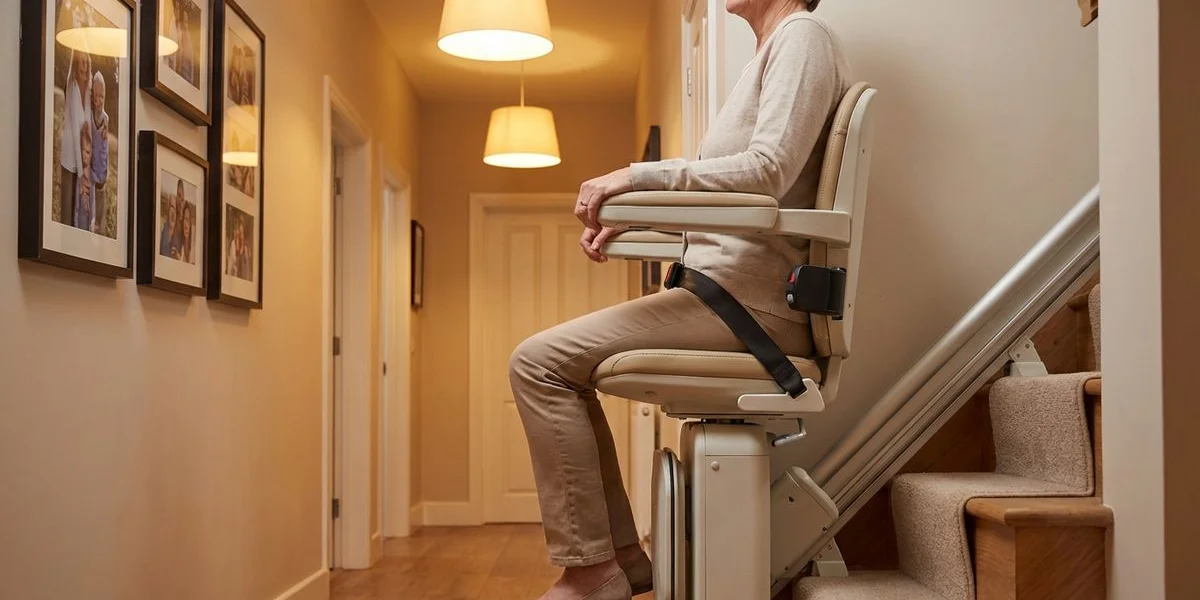
Reliable Stair Lifts for Full-Home Access and Aging in Place
Stair lifts give seniors and mobility-challenged individuals safe, reliable access to every level of their home. Modern stair lifts feature battery backup for power outages, smooth and quiet operation, adjustable seats, and custom rail configurations for straight or curved staircases. Regaining access to bedrooms, laundry, and living spaces eliminates one of the primary reasons families consider facility placement.
What Stair Lifts Include
Why Stairs Become the Biggest Barrier to Aging in Place
For millions of American seniors living in multi-story homes, stairs represent the single greatest obstacle to maintaining independence. According to the National Safety Council, stairway falls account for over one million injuries per year among older adults, and the inability to safely navigate between floors is the number one reason families begin considering assisted living placement.
The consequences of losing stair access extend far beyond inconvenience. Seniors who cannot reach their upstairs bedroom may resort to sleeping on a couch or in a makeshift ground-floor arrangement, losing the comfort and dignity of their own room. Those who cannot access a basement laundry room lose the ability to manage their own household. When an entire floor of the home becomes off-limits, the sense of confinement and lost independence can significantly impact mental health and quality of life.
A stair lift provides an elegant, safe solution to this challenge. By restoring full access to every level of the home, a stair lift eliminates the primary trigger for facility placement conversations and empowers seniors to continue living independently in the homes they love.
Understanding Modern Stair Lift Technology
Today’s residential stair lifts bear little resemblance to the bulky, noisy models of decades past. Modern engineering has produced stair lifts that are sleek, whisper-quiet, and remarkably reliable.
Rack-and-pinion drive systems have replaced older worm-gear mechanisms, delivering a smooth, jerk-free ride at a consistent speed. The drive motor is typically housed within the carriage unit itself, reducing noise and mechanical complexity compared to systems that rely on cables or chains.
Battery-powered operation is now standard on quality stair lifts. The lift charges continuously while parked at either end of the rail, and the onboard batteries provide enough power for multiple round trips during a power outage. This is a critical safety feature in areas prone to storms or grid instability.
Integrated safety sensors detect obstructions on the staircase and automatically stop the lift if anything is in its path. Pressure-sensitive edges on the footrest and carriage halt movement instantly on contact, preventing injury to pets, children, or objects left on the stairs.
Swivel seat locking allows the seat to rotate at the top of the stairs so the user can dismount facing away from the staircase, eliminating the need to twist or turn while stepping off the lift at an elevated landing.
Straight Versus Curved Stair Lifts: Which Do You Need?
The configuration of your staircase determines which type of stair lift is appropriate for your home. Understanding the differences helps you anticipate costs and timelines.
Straight stair lifts are designed for staircases that travel in a single direction without turns, landings, or intermediate platforms. The rail is typically a standard aluminum track that can be cut to length on-site during installation. Straight installations are the most affordable option and can be completed in as little as two to four hours.
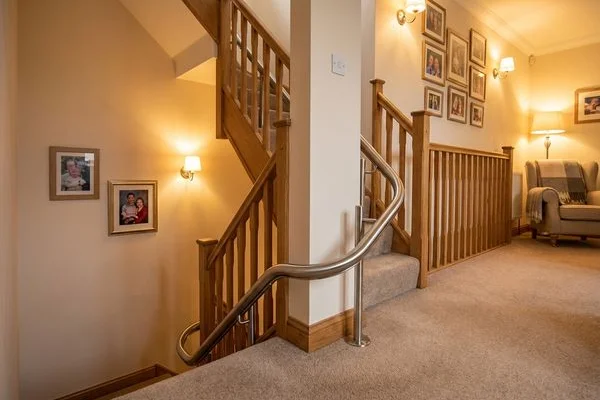
Curved stair lifts are engineered for staircases that include turns, landings, intermediate platforms, or spiral configurations. Because every curved staircase has a unique geometry, the rail must be custom-manufactured to follow the exact contour of your specific stairs. This fabrication process typically takes two to three weeks after precise measurements are taken during the in-home survey.
Outdoor stair lifts are weather-resistant models designed for exterior staircases, porches, and deck access. These units feature marine-grade components, waterproof covers, and corrosion-resistant rails that withstand rain, snow, and temperature extremes.
Planning Tip: If your home has both a straight interior staircase and an exterior staircase with steps, a combination of a straight indoor lift and an outdoor lift may be more cost-effective than a single curved model, while providing comprehensive access throughout your property.
The Real Cost Comparison: Stair Lift Versus Assisted Living
When families face the stair access challenge, the choice often comes down to two options: install a stair lift or begin the transition to single-level assisted living. The financial comparison is dramatic.
| Option | One-Time Cost | Monthly Cost | Year 1 Total | 3-Year Total |
|---|---|---|---|---|
| Straight Stair Lift | $2,500 - $5,000 | $0 | $2,500 - $5,000 | $2,500 - $5,000 |
| Curved Stair Lift | $8,000 - $15,000 | $0 | $8,000 - $15,000 | $8,000 - $15,000 |
| Assisted Living | $0 | $5,000 - $8,000 | $60,000 - $96,000 | $180,000 - $288,000 |
Even the most expensive curved stair lift installation represents less than three months of median assisted living costs. When you factor in the emotional value of remaining in a familiar home surrounded by personal belongings, neighborhood connections, and decades of memories, the case for a stair lift becomes even more compelling.
Installation Day: A Step-by-Step Walkthrough
Understanding what happens on installation day helps families prepare and set expectations for a smooth experience.
Pre-installation preparation is minimal. Clear the staircase of any rugs, plants, or decorative items. Ensure the installer has easy access to the top and bottom of the stairs, and make sure there is a power outlet within reach of the bottom landing where the lift will charge.
Rail mounting is the first major step. The installer anchors the rail track to the stair treads using heavy-duty brackets. For straight installations, the rail is cut to the precise length on-site. The rail is positioned close to the wall to maximize available staircase width for other users.
Carriage and seat assembly follows rail installation. The motorized carriage unit is attached to the rail, and the seat, armrests, footrest, and safety belt are assembled and adjusted for the primary user’s height and comfort preferences.
Electrical connection involves plugging the charging station into a standard household outlet. No special wiring or dedicated circuits are required. The charging station keeps the onboard batteries topped off whenever the lift is parked.
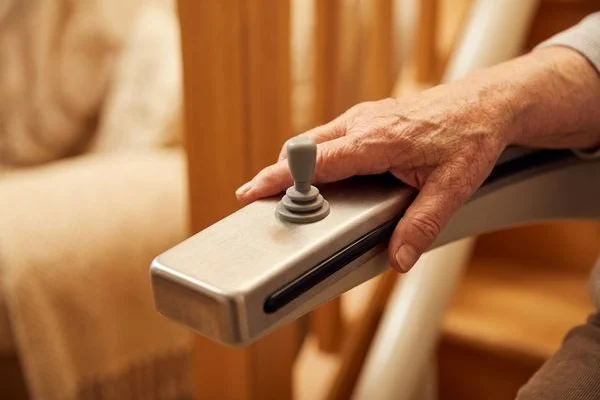
Testing and training completes the process. The installer runs the lift through multiple complete cycles, tests all safety sensors, and demonstrates proper operation to the user and family members. You will practice boarding, riding, dismounting, using the swivel seat, and operating the remote controls.
Maintenance and Long-Term Reliability
Quality stair lifts are designed for years of reliable daily use with minimal maintenance requirements. Understanding the maintenance expectations helps you plan for the long term.
Regular maintenance includes periodic lubrication of the rail, typically every six to twelve months depending on usage frequency. Most manufacturers provide a lubrication kit and simple instructions that homeowners can follow without professional assistance.
Battery replacement is the most common maintenance item. Onboard batteries typically last three to five years depending on usage patterns and power outage frequency. Replacement batteries cost $50 to $150 and can be installed by the homeowner or a service technician.
Annual service inspections are recommended by most manufacturers and are often included in warranty or service agreements. A technician checks all mechanical components, safety sensors, electrical connections, and battery condition during these visits.
Warranty coverage varies by manufacturer but typically includes two to five years on mechanical components and one to two years on electrical components and batteries. Extended warranty options are available for additional peace of mind.
With proper care, a quality stair lift installation will serve your family reliably for ten years or more, making it one of the most durable and cost-effective aging-in-place investments available. Contact our team today to schedule your free in-home staircase survey and discover how quickly you can restore full home access for your loved one.
Stair Lifts Pricing Options
One-time investments that cost a fraction of annual facility care.
Straight Staircase Lift
- Standard rail up to 15 feet
- Padded swivel seat
- Battery backup system
Curved Staircase Lift
- Custom-fabricated rail system
- Navigates landings and corners
- Battery backup system
- Remote call and send controls
Heavy-Duty Model
- Weight capacity up to 400 lbs
- Reinforced seat and rail
- Battery backup system
- Extra-wide seat option
- Outdoor-rated models available
Why Families Choose Our Stair Lifts
Eliminates the Top Reason for Moving
Stairs are the number one reason families consider moving seniors to single-level assisted living. A stair lift removes this barrier entirely, preserving access to the full home.
Battery Backup Safety
All recommended models include battery backup systems that operate during power outages, ensuring your loved one is never stranded between floors during an emergency.
Minimal Home Disruption
Straight stair lift installations take just two to four hours with no structural modifications to your home. The rail mounts to the stair treads, not the wall.
Space-Saving Design
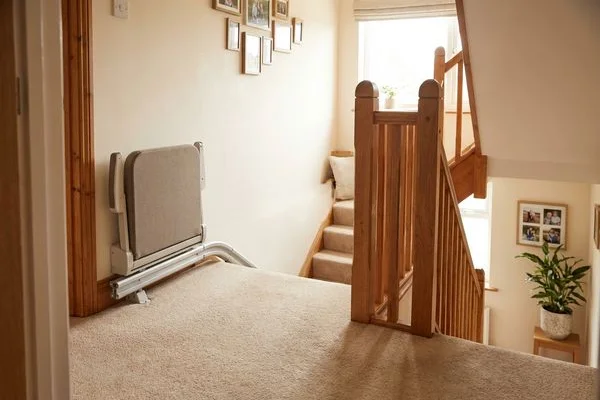
When not in use, the seat, armrests, and footrest fold up against the wall. Many models also feature a folding rail at the bottom to keep the lower landing clear.
Smooth and Quiet Operation
Modern stair lifts use rack-and-pinion drive systems that produce minimal noise and provide a gentle, smooth ride without jerking or sudden stops.
Investment Recovery at Resale
Quality stair lifts retain value and can be resold or transferred if no longer needed. Many families recover 30 to 50 percent of their investment through resale markets.
How Stair Lifts Work
In-Home Staircase Survey
A certified mobility specialist measures your staircase dimensions, evaluates rail mounting options, and identifies the optimal lift configuration for your home layout.
Model Selection
Based on your staircase type, mobility needs, and budget, we recommend the best stair lift model with appropriate seat width, weight capacity, and control options.
Custom Rail Fabrication
For curved staircases, custom rails are precision-manufactured to follow every angle and landing of your specific staircase, ensuring a perfect fit.
Installation and Training
Professional installation is completed in as little as two to four hours for straight staircases. Your specialist provides hands-on training for safe operation and maintenance.
Save $50,000+ Per Year With Home Safety Modifications
A one-time investment in stair lifts costs a fraction of annual assisted living fees. Get a free assessment to see your potential savings.
Get a Free AssessmentSee Our Work
What Families Say About Stair Lifts
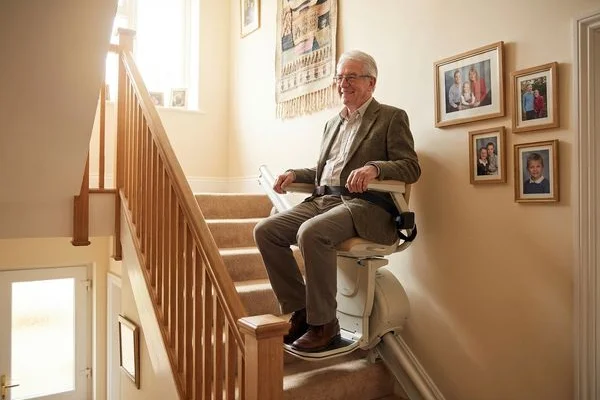
"Dad had been sleeping on the living room couch for months because he could not safely climb the stairs to his bedroom. The stair lift gave him back his entire home. Installation took about three hours and the battery backup gives us peace of mind during Texas storms."
"We looked into assisted living and were quoted $6,500 a month. The curved stair lift for Mom's split-level home was $10,000 total. That one-time investment versus $78,000 a year was an easy decision. She uses it multiple times a day and loves her independence."
"The installation team was incredibly professional. They measured everything precisely and the lift glides up the stairs so smoothly and quietly you barely notice it. Mom can fold it up when guests come over. Best money we ever spent on her safety."
Common Questions About Stair Lifts
How much does a stair lift cost?
Can a stair lift be installed on any staircase?
Will a stair lift damage my stairs or walls?
How long does installation take?
What happens during a power outage?
What is the weight capacity of a stair lift?
Can other family members still use the stairs normally?
Is there a rental option available?
Related Home Safety Solutions
Safety Assessments
Room-by-room safety assessments identifying fall risks, accessibility barriers, and recommended modifications.
Learn More →Ramps
Custom ramp installations and outdoor accessibility modifications for safe home entry and exit.
Learn More →Walk-in Tubs
Low-threshold entry tubs with anti-slip flooring and hydrotherapy features designed for safe, independent bathing.
Learn More →Try Our Free Cost Calculator
Compare the cost of home modifications versus assisted living to see how much your family can save.
Use Cost CalculatorGet Your Free Stair Lifts Assessment
Take the first step toward a safer home. Our certified specialists help you understand your options, estimated costs, and potential savings versus facility care.
Get a Free Assessment